In Etruscan mythology, Charun (or Charu) was one of the world bury psychopomp called Hades. The name of the equivalent figure from Greek mythology Charon.
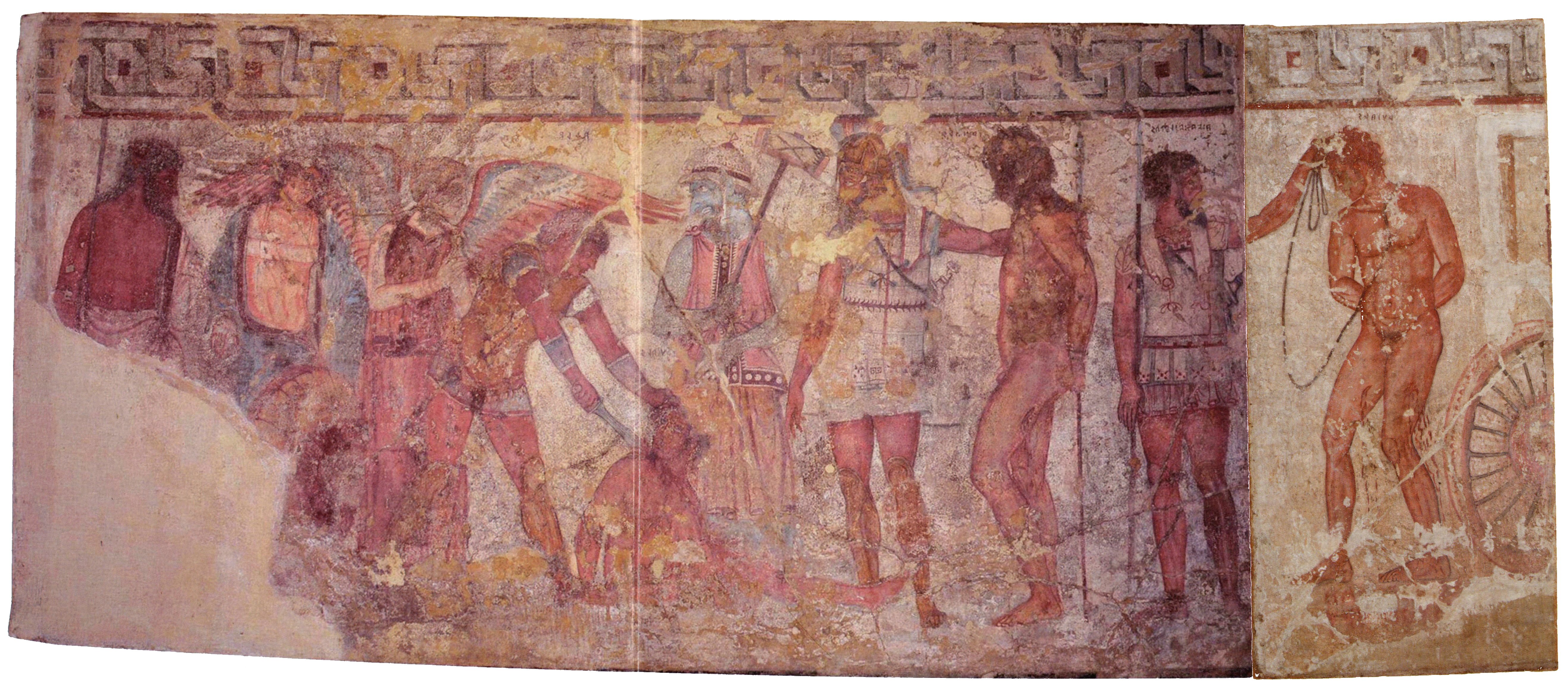
Charun (the name is derived from some Etruscan inscriptions) is reproduced in tomb paintings, sarcophagi, urns, vases and funerary stele. Typical illustration is fundamentally different from Charon, represented, usually, at the helm of a boat fitted with oars, which act as ferryman of souls. The Etruscan demon of death, however, is a figure accompanying the deceased on the last trip (on foot, horseback, wagon) to the afterlife, snatching them out of their loved ones to greet and escort them to their final destination. Sometimes it is represented to protect the gates of Hades (as, for example, in the Tomb and the Tomb of the Caronti Anina Tarquinia) or otherwise in connection with the death (as, for example, in the François Tomb of the volcano). It comes with a beard, pointed ears and nose of a vulture and wears a short tunic and high boots. Funeral is depicted in paintings with a bluish color. Sometimes it snakes around the arms and huge wings (as, for example, in the Tomb of Orcus Tarquinia). She is holding a hammer in his hand, his religious symbol, like ax ax Roman. Sometimes it is also equipped with a sword. It is often accompanied by the goddess Vanth (as, for example, in the Tomb of Anina Tarquinia and François Tomb of Vulcan), a winged goddess also associated with the underworld. Some
(Larissa Bonfante) Charun is just a guide for the dead, similar to Greek mythology, while others (De Franz. RUYT) also had the role of god who punishes evil.
Some authors (De Franz. RUYT) compare it to the Celtic god Sucellos, since the latter also has a hammer in his hand and has the same function as the god of death.
regard to the meaning of the hammer it was thought that the same would serve to close the gates of the bolts, thus preventing the deceased to come back or to strike its victims or, more likely, to frighten them. The hammer Charun, however, could also be interpreted in relationship to Etruscan myth (as represented in a bronze mirror from Perugia, the late fourth century BC, preserved in the State Museum of Berlin), which attributed to the goddess Atharpa would conflict with the act of a hammer a nail to fix immutably the fate of men.

In Etruscan mythology, Vanth is a god of the underworld (Aita). And winged, omniscient, and a messenger of death for men. Assist patients in dying and inhale the good demons. During the late gradually came to represent Justice. Is represented in art with snakes, torches and keys, and often is accompanied by the god Charun (according to some scholars would be his wife).
According to Jeff Rovin (see bibliography), Vanth encourages violence and is attracted by the open graves.
http://spazioinwind.libero.it/popoli_antichi/Etruschi/religione.html
The Etruscans believed nell'ineluttabilità of fate, the limit could only make their stay more pleasant earth, so were making parties and magical rites. They believed in the afterlife, particularly in hell, which had a door, called mundus, guarded by the terrifying figure of Tuchulcha demon, a monster with donkey ears, the nose of a vulture and hair made from snakes. This figure is more its presence in the decline of the Etruscan culture, characterized by the presence of death and persecution.
The demon of the underworld was Charun, which accompanies the dead in the afterlife, from which evokes the figure of Charon, he wore a cape and wearing a hammer in his hand, similar to that used today for the burial of the Pope, the which embraces three times the time of the deceased pontiff. A typical funeral game is tied to the myth of phersu, the source of the word "person" who incites a dog against a person with his head covered by a lot, which is tied slowly. The ravening dog and the person is a witness to the inevitability of fate. The tombs represent scenes of daily life: joy, parties, lunches and, in recent years, pain and terror. They adopted a calendar introduced by Tarquini, with influences from Mesopotamia, and later modified by Caesar, always with the help of Tirrenia. It recalls the sacred festivals and events. They had divided the ten saeculum after which there would be the end of the Tyrrhenian civilization, as indeed was confirmed by history.
history of the origin of the Etruscan cities dominate almost exclusively in fact we see a funeral, which is that of cremation, which can not but reflect concepts foreign to those of the material link between spirit and body of the deceased, on the contrary, at least in the full age history, it sometimes seems to mean the idea of "liberation" of the soul from the shackles of matter to a celestial sphere. Is all the more curious to observe how the Etruscan tombs of the period Villanova Orientalizing ash and burned bones of the dead are contained in the polls sometimes in the form of housing or within vessels that attempt to reproduce the features of the dead (the so-called "canopy" of closed): what it reveals, since the earliest times of the formation of the Etruscan nation, a mixture of beliefs and perhaps a reaffirmation of the Mediterranean tradizionifunerarie the widespread custom of cremation by the followers. It can be said that the idea of survival in the grave absolutely exclude a belief in the transmigration of souls into a realm of "'beyond'. But it is certain that in Etruria the latter concept is saying, tangible progress was under the influence of religion and Greek mythology, the diminishing of the primitive beliefs: and configured according to the Homeric vision of the Averno, populated by chthonic deities , spirits of ancient heroes and shadows of the dead. Already in the fourth century monuments of Ve, and above all in those of the Hellenistic period, the future destiny of the soul is represented as a journey to the realm of the dead and as a stay in the underworld. Stay sad, hopeless, sometimes dominated by the fear that strikes the presence of monstrous demons, or even the torments that they deal with souls. It is, in essence, the embodiment of death anxiety in an essentially primitivistic eschatology. And to symbolize the death of two figures are especially hellish: the goddess Vanth large wings and with the torch, which, like the Greek Moira, fate is relentless, and the demon Charun, semibestiale figure armed with a heavy hammer, which can be regarded a fearful strain of greek Charon from which it takes its name. Both of Vanth Charun are both multiplication, perhaps with their own individuality and its own middle name. But the infernal demonology is rich and picturesque, and meet other characters, like the horrifying Tuchulcha-faced vulture, ears of an ass and armed with snakes, largely welcomed the chthonic symbolism of animals, like the snake and the horse.
Among the practices of a religious character than for the dead at the Etruscans had a very special character. They were linked to the concept (which are spread to other civilizations of the Mediterranean) that the vital activity of the deceased, his''individuality "to continue after death and that this survival took place in the grave. But it is the living, family and relatives, to ensure the survival of the entity to which the deceased's life had to be given a grave, that a new house, and one set of clothes, personal objects, food, which he used symbolically or magically. For the same reason they were sent to the vitality and strength late in games and athletic contests that were held on the occasion of the funeral or the anniversary of his death. As for the funeral of their practices, the practice was not unlike what happened elsewhere: to the late public exposure of the corpse and the lamentations of women specially paid (mourners), funeral and feast at the tomb. The cult of the''survival in the tomb was further developed in ancestor worship and especially the parent, especially of noble families. Between the fifth and fourth centuries BC, however, the survival of the faith of the dead in the grave under the changed 'effect of the suggestions coming from civilization Greek. It was replaced by the concept of a''world of the dead "(or similar Averno Hades) where the''shadow" holiday. The dead were then devoted special rites of suffrage, drawn from the books of Acheron, and offerings to the gods infernal (especially the blood of some animals) that could allow the souls to achieve a special state of bliss.
http://www.capurromrc.it/devil/7340vanthf.html
http://en.wikipedia.org/wiki/Vanth
Vanth is a chthonic figures shown in Etruscan mythology in a variety of forms of funerary art, Such as in tomb paintings and on sarcophagi. Vanth is a female demon in the Etruscan underworld that is often accompanied either by additional Vanth figures or by another demon, Charun (later referred to as Charu). Both Vanth and Charun are only seen in iconography beginning c. 400 BC, in the middle period of Etruscan art, although some earlier inscriptions mention her name.[1] Vanth has no direct counterpart in Greek mythology, and is very frequently, but not always, seen winged. Although Vanth has no real Greek counterpart, she has been compared to the Greek Furies, the Erinyes, especially in older publications,[2] This is an unlikely association since she is almost always shown in Etruscan iconography to be a benevolent guide, not an avenging spirit, which the Furies often represent. Her other attributes include the possession of a torch, key, or scroll, and she is shown often to be bare-chested with cross-straps across her breast, adorned with fur boots, a rolled short chiton, and sometimes with unattached sleeves. In fact her dress has been attributed by Scheffer as specifically the dress of a huntress.[3]
Vanth is involved in a variety of different types of scenes in Etruscan art[4]; the most common types associate her presence with occasions of slaughter and murder, including scenes from the Trojan cycle. Occasionally she is shown rising up out of the ground in such contexts, as seen on an ash urn from Chiusi.[5] Sometimes she is even shown as a solitary figure decorating the sides of ash urns. Other scenes in which Vanth is present involve the meeting and escort of the dead, in the role of psychopompos, who are either walking or being transported on horseback, wagon, or chariot.[6] In general, Vanth is associated with death and the journey of the deceased to the Underworld, but in a variety of different ways; she is present in scenes of the moment of death as well in scenes where the deceased is already fully dead and journeying to the Underworld. She is depicted as a benevolent psychopompian figure, in contrast to the menacing Charun, her sometime companion.
The materials that Vanth is identified as carrying, which include a torch, key, scroll, or sword, also relate to her role as guide in the Underworld. The torch can be used to light the way for travelers to the Underworld, although some scholars interpret it as a status symbol or as an indication of office,[7] and the key unlocks its doorway. Additionally, the scroll may reveal more about the nature of this demon, as one instance actually displays her name inside, vanθ.[8] Vanth has been interpreted as a goddess of fate, and using this association, the scroll may contain the destiny of the deceased. However, in total, Vanth is depicted as a young, vibrant female chthonic figure, sometimes in the company of other Vanths, and sometimes with Charun; She is a figure who assists with the journey of the deceased to the Underworld
[edit] Etruscan Chthonic Deities
Other Etruscan Chthonic (or underworld) figures include Charun, Aita/Calu, Phersipnai, Turms Aitas, and Culsu


http://www.instoria.it/home/Stitchedefin.jpg
http://www.instoria.it/home/FrancoisV.htm

0 comments:
Post a Comment