Thursday, October 16, 2008

Hematoma From Wisdom Teeth

Charun and archeology

In Etruscan mythology, Charun (or Charu) was one of the world bury psychopomp called Hades. The name of the equivalent figure from Greek mythology Charon.

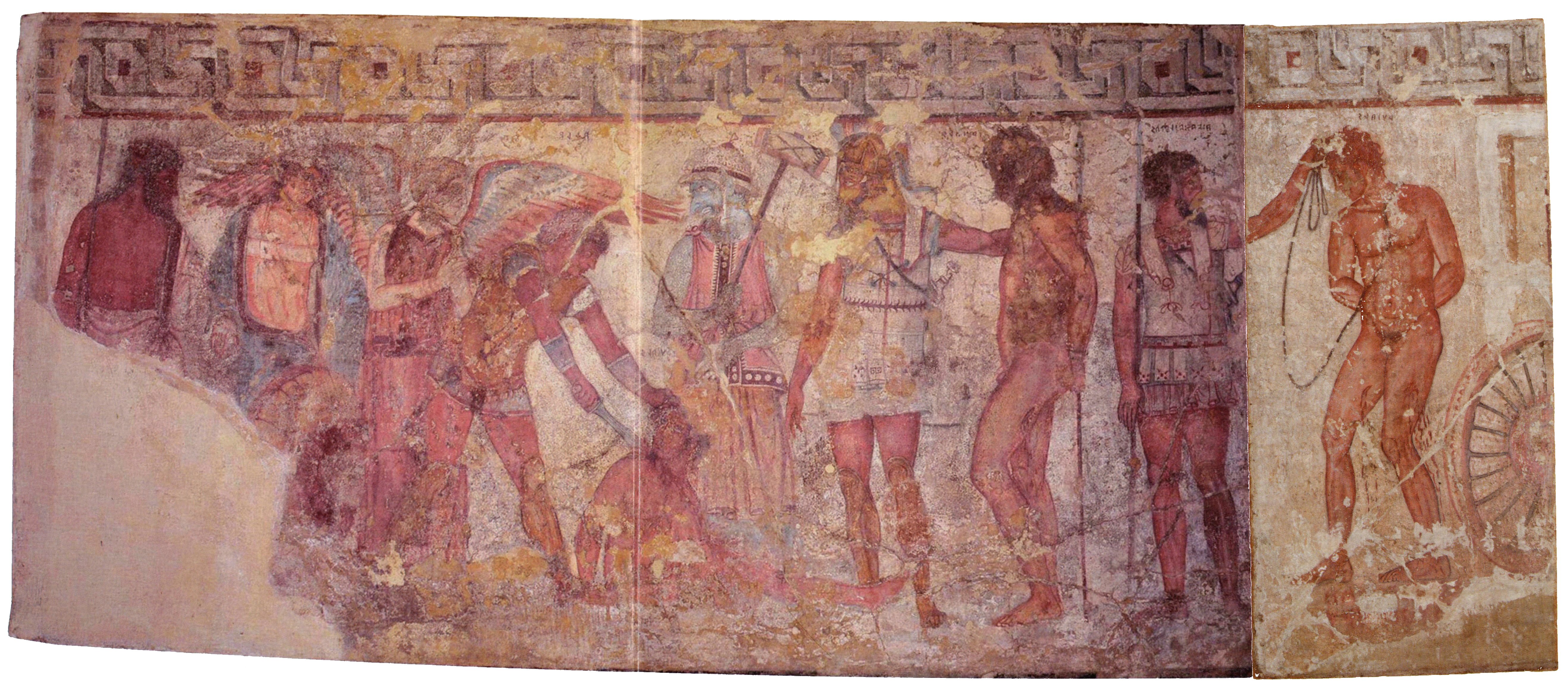
Charun (the name is derived from some Etruscan inscriptions) is reproduced in tomb paintings, sarcophagi, urns, vases and funerary stele. Typical illustration is fundamentally different from Charon, represented, usually, at the helm of a boat fitted with oars, which act as ferryman of souls. The Etruscan demon of death, however, is a figure accompanying the deceased on the last trip (on foot, horseback, wagon) to the afterlife, snatching them out of their loved ones to greet and escort them to their final destination. Sometimes it is represented to protect the gates of Hades (as, for example, in the Tomb and the Tomb of the Caronti Anina Tarquinia) or otherwise in connection with the death (as, for example, in the François Tomb of the volcano). It comes with a beard, pointed ears and nose of a vulture and wears a short tunic and high boots. Funeral is depicted in paintings with a bluish color. Sometimes it snakes around the arms and huge wings (as, for example, in the Tomb of Orcus Tarquinia). She is holding a hammer in his hand, his religious symbol, like ax ax Roman. Sometimes it is also equipped with a sword. It is often accompanied by the goddess Vanth (as, for example, in the Tomb of Anina Tarquinia and François Tomb of Vulcan), a winged goddess also associated with the underworld. Some
(Larissa Bonfante) Charun is just a guide for the dead, similar to Greek mythology, while others (De Franz. RUYT) also had the role of god who punishes evil.
Some authors (De Franz. RUYT) compare it to the Celtic god Sucellos, since the latter also has a hammer in his hand and has the same function as the god of death.
regard to the meaning of the hammer it was thought that the same would serve to close the gates of the bolts, thus preventing the deceased to come back or to strike its victims or, more likely, to frighten them. The hammer Charun, however, could also be interpreted in relationship to Etruscan myth (as represented in a bronze mirror from Perugia, the late fourth century BC, preserved in the State Museum of Berlin), which attributed to the goddess Atharpa would conflict with the act of a hammer a nail to fix immutably the fate of men.


In Etruscan mythology, Vanth is a god of the underworld (Aita). And winged, omniscient, and a messenger of death for men. Assist patients in dying and inhale the good demons. During the late gradually came to represent Justice. Is represented in art with snakes, torches and keys, and often is accompanied by the god Charun (according to some scholars would be his wife).

According to Jeff Rovin (see bibliography), Vanth encourages violence and is attracted by the open graves.

http://spazioinwind.libero.it/popoli_antichi/Etruschi/religione.html

The Etruscans believed nell'ineluttabilità of fate, the limit could only make their stay more pleasant earth, so were making parties and magical rites. They believed in the afterlife, particularly in hell, which had a door, called mundus, guarded by the terrifying figure of Tuchulcha demon, a monster with donkey ears, the nose of a vulture and hair made from snakes. This figure is more its presence in the decline of the Etruscan culture, characterized by the presence of death and persecution.

The demon of the underworld was Charun, which accompanies the dead in the afterlife, from which evokes the figure of Charon, he wore a cape and wearing a hammer in his hand, similar to that used today for the burial of the Pope, the which embraces three times the time of the deceased pontiff. A typical funeral game is tied to the myth of phersu, the source of the word "person" who incites a dog against a person with his head covered by a lot, which is tied slowly. The ravening dog and the person is a witness to the inevitability of fate. The tombs represent scenes of daily life: joy, parties, lunches and, in recent years, pain and terror. They adopted a calendar introduced by Tarquini, with influences from Mesopotamia, and later modified by Caesar, always with the help of Tirrenia. It recalls the sacred festivals and events. They had divided the ten saeculum after which there would be the end of the Tyrrhenian civilization, as indeed was confirmed by history.
history of the origin of the Etruscan cities dominate almost exclusively in fact we see a funeral, which is that of cremation, which can not but reflect concepts foreign to those of the material link between spirit and body of the deceased, on the contrary, at least in the full age history, it sometimes seems to mean the idea of "liberation" of the soul from the shackles of matter to a celestial sphere. Is all the more curious to observe how the Etruscan tombs of the period Villanova Orientalizing ash and burned bones of the dead are contained in the polls sometimes in the form of housing or within vessels that attempt to reproduce the features of the dead (the so-called "canopy" of closed): what it reveals, since the earliest times of the formation of the Etruscan nation, a mixture of beliefs and perhaps a reaffirmation of the Mediterranean tradizionifunerarie the widespread custom of cremation by the followers. It can be said that the idea of survival in the grave absolutely exclude a belief in the transmigration of souls into a realm of "'beyond'. But it is certain that in Etruria the latter concept is saying, tangible progress was under the influence of religion and Greek mythology, the diminishing of the primitive beliefs: and configured according to the Homeric vision of the Averno, populated by chthonic deities , spirits of ancient heroes and shadows of the dead. Already in the fourth century monuments of Ve, and above all in those of the Hellenistic period, the future destiny of the soul is represented as a journey to the realm of the dead and as a stay in the underworld. Stay sad, hopeless, sometimes dominated by the fear that strikes the presence of monstrous demons, or even the torments that they deal with souls. It is, in essence, the embodiment of death anxiety in an essentially primitivistic eschatology. And to symbolize the death of two figures are especially hellish: the goddess Vanth large wings and with the torch, which, like the Greek Moira, fate is relentless, and the demon Charun, semibestiale figure armed with a heavy hammer, which can be regarded a fearful strain of greek Charon from which it takes its name. Both of Vanth Charun are both multiplication, perhaps with their own individuality and its own middle name. But the infernal demonology is rich and picturesque, and meet other characters, like the horrifying Tuchulcha-faced vulture, ears of an ass and armed with snakes, largely welcomed the chthonic symbolism of animals, like the snake and the horse.
Among the practices of a religious character than for the dead at the Etruscans had a very special character. They were linked to the concept (which are spread to other civilizations of the Mediterranean) that the vital activity of the deceased, his''individuality "to continue after death and that this survival took place in the grave. But it is the living, family and relatives, to ensure the survival of the entity to which the deceased's life had to be given a grave, that a new house, and one set of clothes, personal objects, food, which he used symbolically or magically. For the same reason they were sent to the vitality and strength late in games and athletic contests that were held on the occasion of the funeral or the anniversary of his death. As for the funeral of their practices, the practice was not unlike what happened elsewhere: to the late public exposure of the corpse and the lamentations of women specially paid (mourners), funeral and feast at the tomb. The cult of the''survival in the tomb was further developed in ancestor worship and especially the parent, especially of noble families. Between the fifth and fourth centuries BC, however, the survival of the faith of the dead in the grave under the changed 'effect of the suggestions coming from civilization Greek. It was replaced by the concept of a''world of the dead "(or similar Averno Hades) where the''shadow" holiday. The dead were then devoted special rites of suffrage, drawn from the books of Acheron, and offerings to the gods infernal (especially the blood of some animals) that could allow the souls to achieve a special state of bliss.

http://www.capurromrc.it/devil/7340vanthf.html


http://en.wikipedia.org/wiki/Vanth


Vanth is a chthonic figures shown in Etruscan mythology in a variety of forms of funerary art, Such as in tomb paintings and on sarcophagi. Vanth is a female demon in the Etruscan underworld that is often accompanied either by additional Vanth figures or by another demon, Charun (later referred to as Charu). Both Vanth and Charun are only seen in iconography beginning c. 400 BC, in the middle period of Etruscan art, although some earlier inscriptions mention her name.[1] Vanth has no direct counterpart in Greek mythology, and is very frequently, but not always, seen winged. Although Vanth has no real Greek counterpart, she has been compared to the Greek Furies, the Erinyes, especially in older publications,[2] This is an unlikely association since she is almost always shown in Etruscan iconography to be a benevolent guide, not an avenging spirit, which the Furies often represent. Her other attributes include the possession of a torch, key, or scroll, and she is shown often to be bare-chested with cross-straps across her breast, adorned with fur boots, a rolled short chiton, and sometimes with unattached sleeves. In fact her dress has been attributed by Scheffer as specifically the dress of a huntress.[3]

Vanth is involved in a variety of different types of scenes in Etruscan art[4]; the most common types associate her presence with occasions of slaughter and murder, including scenes from the Trojan cycle. Occasionally she is shown rising up out of the ground in such contexts, as seen on an ash urn from Chiusi.[5] Sometimes she is even shown as a solitary figure decorating the sides of ash urns. Other scenes in which Vanth is present involve the meeting and escort of the dead, in the role of psychopompos, who are either walking or being transported on horseback, wagon, or chariot.[6] In general, Vanth is associated with death and the journey of the deceased to the Underworld, but in a variety of different ways; she is present in scenes of the moment of death as well in scenes where the deceased is already fully dead and journeying to the Underworld. She is depicted as a benevolent psychopompian figure, in contrast to the menacing Charun, her sometime companion.

The materials that Vanth is identified as carrying, which include a torch, key, scroll, or sword, also relate to her role as guide in the Underworld. The torch can be used to light the way for travelers to the Underworld, although some scholars interpret it as a status symbol or as an indication of office,[7] and the key unlocks its doorway. Additionally, the scroll may reveal more about the nature of this demon, as one instance actually displays her name inside, vanθ.[8] Vanth has been interpreted as a goddess of fate, and using this association, the scroll may contain the destiny of the deceased. However, in total, Vanth is depicted as a young, vibrant female chthonic figure, sometimes in the company of other Vanths, and sometimes with Charun; She is a figure who assists with the journey of the deceased to the Underworld

[edit] Etruscan Chthonic Deities

Other Etruscan Chthonic (or underworld) figures include Charun, Aita/Calu, Phersipnai, Turms Aitas, and Culsu


http://www.instoria.it/home/Stitchedefin.jpg

http://www.instoria.it/home/FrancoisV.htm

Congratulations On Getting A Job Phrases

Vanth

http://209.85.135.104/search?q=cache:1eSGIlybihcJ:www.loescher.it/mediaclassica/Latino/Lessico/mundus.pdf+mundus+oltretomba&hl=it&ct=clnk&cd=3&gl=it

L ' Archaeology can tell us at least an interesting thing in ages before the foundation of Rome
use was shaped mostly circular or semicircular is widespread among people of Latin
. The use of
these would seem to extend to people having to Italy (Umbria), as shown in the Tables of Gubbio
translation made by Giacomo Devoto

14, which suggests that the word
umbra "ruseme" to mean "grave" and is comparable to the Roman mundus
also on the basis that a form of worship based on a pit seems consistent with the nature goddess of the underworld
Prestota is dedicated to the cult.
Excavations at Satricum, Volscian city of Latium, on the Palatine in Rome, What
(Ansedonia) and Tarquinia confirm the custom was to dig for different purposes, such as
pantry for storing food, for religious purposes, as a rite of the founding of the city. A
Satricum excavations on the rock led to the discovery of traces of a prehistoric village
, dating from the late Bronze Age, Early Iron Age (IX-VIII century BC), formed by
huts mostly oval, with the roof supported by poles and covered with twisted branches and straw
.
At the center of the fortress you see today the ruins of the temple dedicated to the Mater
Matuta, inside the sacred enclosure are the remains of a hut belonging to the settlement
prehistoric larger than the others, believed were have been used in sacred worship, therefore, was incorporated
in the new temple complex. This gives
hut on a pit dug into the floor inside the cabin itself,
the fossil record that were found in use suggest a cult and has
advanced the hypothesis that the pit might be a mundus .
was similar, even large were found on the Palatine in Rome.
In this case, the discovery was particularly exciting because
the discovery of a walled city, dating back to centuries. VIII BC and mail to the roots of the Palatine, led to believe they have found
Romulea the walls of the foundation of the city, reopening the debate on the dating
the foundation of Rome and re-applying strength indicates that the ancient vulgate April 21
year 753 BC as the birth of Rome.
not our job to question the merits of the vast and exciting
the birth of Rome, if not limited to any particular concerning the question of
mundus.
appear persuasive the arguments that Andrea Carandini, an archaeologist who has discovered the
the roots of the Palatine walls, bases its belief that it is the walls of the founding of Rome
:
1. the walls date from the VIII century BC
2. the path is interrupted by a door located in the very place where according to tradition would be
Mugoni the door;
3. the path to walk Palatine just follows the path indicated by Tacitus

15 and 16
Ovid

for the original boundary wall;
4. the walls do not have the character of defensive walls, are in fact low, at the foot of the hill
, while the defense would be more reasonable to put them up as a further reinforcement of the walls
very steep at that point;
5. if not defensive, is likely to have a sacred meaning
, mark a sacred space;
6. human bodies were found buried within the walls. Their presence has sparked new discussions
. Bodies could be buried in graves in a cemetery that the walls
crossed - in this case would be impossible to claim that the walls have a sacred character
- but could be the indicator of human sacrifice, as does the thinking
position of the body of a woman curled up on itself which may have been buried alive
. In this case, the sanctity of the walls is confirmed;
7. within the stone walls have been incorporated in
terminals that probably had first had the task of keeping track of the visible wake up
which would arise due to the walls. The acquisition of these stones at the base of the walls themselves
is interpreted as a synthesis of Latin ritual within a ritual Etruscan;
fact while building the walls of the groove on the track primitive part of the ritual
Etruscan foundation, the worship of the god Terminus, and the respect of the stones is terminal
Latin heritage.
If the walls are really at the base of the Palatine walls of Romulus or better
age of Romulus, crowds have not been tried on the Palatine Hill, on the contrary Cermalo corresponding
SW corner of the Palatine, the traces of the foundation of Romuli city and home.
Excavations archaeologist Paul Brocato
17
the summit of the Palatine certify that the site was inhabited since
sec. IX, in the long period of time between the end of the Bronze Age (900 BC) to the late republic
(century BC) passed through seven different stages of evolution
the earliest phase, which dates back to Lazio IIB-III (900-750 BC Late Bronze Age-Early Iron Age
)

18, and prior to Romulus, belong the remains of a hut proto-urban
found in the SO of the Palatine Hill, once said Cermalus Germalus or, as the etymology of which is connected by
Varrone
19
at the root of germanus, brother, to underline the fatal
significance of this hill for the two brothers the legend.
the cabin is only a small part of the base perimeter of the oval-shaped and the base
of two of the four wooden poles supporting the roof, the floor plan is very similar
to that of a building Lanuvium the same era, but also the huts Satricum, city of
Volsci, they mostly look the same plant with predominantly oval
pitched roof of woven branches covered with straw.
Cermalus front of the hut, at a distance of about four feet,
have found the remains of a circular pit, one meter in diameter and 90 cm depth, which is interpreted as
foundation pit of a settlement pre-urban before the age
Romulea.
In the next phase (750-650 BC) in the space occupied by the first and only hut he found three other
located exactly on the same area.
Two of these new huts are huddled together as if they were part of a bipartite
building, the third is a smaller building itself.
front hut it is a pit large, semicircular,
dug in tufa, initially interpreted as a foundation pit
assumption that the two were the first rude huts huddled shrine dedicated to Mars and Ops

20,
hut while the smallest was interpreted as a house of Romulus

21.
This interpretation has been abandoned in the ditch next to the hut was used as a dwelling
recognized a simple pantry.
Carandini believes that the Cermalus, in front of the place where
arose a few centuries after the Temple of Victory, if you can not locate the grave of the founding of
city, the place that represented the eyes of the Romans: it is of a grave, then
reused for another purpose, which was built an altar

22.
This altar has enjoyed a respect and a consideration such that over the centuries have preserved from the
zoning changes that have profoundly changed several times
the character of the surrounding places.
The intercomparison between data and information provided by archeology provided by the literary sources we
leads to a modest result, but not devoid of meaning: the pit mentioned in the legend
is not an invention but rather the myth of a custom widely spread among the peoples of Latin and, if we
Credit for the translation of Devoto (we have no reason not to give him credit), even among some
Italic peoples, namely the Umbrian towns of Gubbio.
These were all had a circular or semicircular, were of various sizes, sometimes
quite large, and were engaged in a variety of uses.
It is not clear for the layman to do as archaeologists to distinguish a foundation pit
from a ditch used as a pantry, but certainly cases does not depend on the particular content, but
of context.
In fact, unlike what happens in Etruria - Tarquinia for example in a foundation pit was found
lituus a trumpet, teaches the king wishes, an ax and a shield, symbols of imperium
military

23 - in Latin was never found objects
significant symbolic meaning, indeed we might add that have never been found in objects
overall, but only fossils of materials burned, with the exception of the tomb that was then
second Carandini re-used to represent the foundation pit of Rome:
this was found a vase There had been deposed in a time subsequent to the time when
had been dug.
Fossils of burnt materials may move towards the recognition was used to worship
use here, too much back to prehistoric eras of Rome prevailed the custom of sacred objects
not throw away broken or damaged but to burn them and bury in favissa
24

the temple to which they belonged.
Plutarch (Rom. 22) mentions lituus of Romulus, who was also king wishes, but he talks like a
curved branch, not as a trumpet of the kind found in Tarquinia, says he was kept on the Palatine but
does not specify where, so do not necessarily mundus; Plutarch
adds that lituus, unearthed at the time of the fire gallic acid, was found
miraculously intact amid the ashes.
Beyond the legend of the miraculous lituus indestructibility of the founder, if he had made a pit
a curved wooden stick in the form of lituus would be completed as the first fruits and crops
that according to the unanimous testimony of Plutarch and Ovid
were also deposited in the grave of the founding of Rome.
So in the store were laid on the grave of food, ie things
similar to those that can be put in the pantry of a house.
the beginning of last century it was suggested that the mundus was a pantry Cereris

26,
but was soon abandoned, although it is not appropriate to return to this position exceeded
not be out of place to reflect on what it means to be laid in the foundation pit
food commodities, perhaps the lituus, never military weapons or symbols of imperium.
This prohibition extends to the whole consecrated area contained within the limit of Pomer.
The procession proceeded to the triumph of the Via Sacra to the door that led into the heart of the city devoted
but no one could go in there armed, not even the Emperor. However, before
embroidery on the symbolic meaning of the deposit buried in the grave may be useful
Carandini trace with the later stages of the ritual of Trustees in the hope that the overview
help clarify the details.

Magdeleine comments that the mundus for its structure looks like a small
microcosm reproducing in miniature the structure of the macrocosm, there is a vaulted ceiling that recalls
the sky, there in a room dedicated to this cult of Ceres, there is still more underground
a pars inferior dis Manibus consecrated. These three elements combine into a single design
heaven, earth and hell, but he said this summary is very little Roman, because the Romans were unable to archaic age
theological thought.
Perhaps this review is to be reviewed.
There is one last clue to be taken into account: the stone that blocks access to the underground world of the dead is called
lapis Manalis because from there pass Mani. Not all deaths are
Hands, Hands are good by definition, are such because they are the souls of
parenthesis, persons of a family from which we expect protection and benevolence
even after death. The world of the dead is a bit 'less scary when considered from this point of view
, although there is no hurry to get there and it is recommended to avoid hazardous activities
religious days in which more easy to cross the threshold that the pencil Manalis closes

Patrick Ewing Sneakers

mundus mundus mundus as a foundation pit

In the story of the founding of Rome made by Plutarch (Rom. 11) it is said that Romulus
summoned to Rome to learn from some Etruscan their
how the founding of the city in compliance with divine and the sacred books. He dug a circular pit "in the place that now is called
Comice 'and then he threw the first fruits of everything. The followers of Romulus, in
time, I threw a handful of their homeland. This grave - says Plutarch - was called by the Romans
mundus, the same word used to refer to the Olympus.
Plutarch goes on to say that the pit called the mundus was considered center of the valley
circular path around it with a plow pulled by an ox and a cow that had been yoked
; this vein was the perimeter of the city walls.
As the plow proceeded, the companions of Romulus followed him, collecting the loose and throwing clods
inside the path. When it came to the point where there would be due
the door, lifted the plow and left a space not affected by the groove:
for this reason the walls are sacred but the doors are not.
The second discrepancy concerns the foundation pit. Ovid agrees with Plutarch in
say that, after the auspices taken on the Palatine Hill, the original act the foundation ceremony of the
digging a pit in which they do not throw the first fruits of all kinds but Fruges (corn, put).
He said that the ditch is deep, get to solidum, namely the layer of rock beneath the surface of
soil, leaves out the detail of the handful of earth from different backgrounds, saying instead that the
pit, after being dug, it again filled and on it is erected an altar that represents a novus
focus.
The mundus of Plutarch is the same as the pit of Ovid?
Evidently the two accounts refer to the same passage of the ceremony
foundation but it is unclear whether this is the same thing, it is the grave of Ovid
filled her life after you have been laid Fruges (corn), while the bothros mentioned by Plutarch,
mundus precisely because it is defined, seems to remain as an empty underground space.
antiquarian sources rather than clarify the issue make it even more complicated, in fact
testimony of Varro, of Festus, see Macrobius to expand the area of semantic word
mundus, more precisely, we see the word doubles as an adjective of the first class
undus-a-um and a noun mundus-ia which they connect to
meanings so different from the doubt of being faced with a case of homophony: the dictionary-Meillet Ernout
suggests that there may be two or even three nouns in meaning and etymology
different.
No indication of antiquarian sources leads us to assimilate the mundus
foundation pit of a city, most of the information concentrates on the mysterious
Cereris mundus, where was the border between the world of the living and the dead, from which
the souls of the hands would sometimes exit to penetrate between the living and that sometimes, on certain very precise
, opened facilitating the descent of the living among the dead.
The grammarian Festus in his De verborum signification, a summary of the work of another
grammarian, the most famous Verrio Flacco, who lived in the Augustan age, writes: mundus appellatur
coelum, land, sea et aer

3. Mundus then as a synonym of Kosmos, which is the sense in which
the word is commonly used in Latin. But the word mundus
also indicates a place underground, with its vaulted ceiling in the likeness of the sky
, dedicated to the Manes and therefore normally closed, open only three times a year in
dates.
Festo, which is our main source of information in a passage very corrupt and therefore difficult to interpret
writes: Cereris here mundus appellatur here ... ter in Solet patere years. In this fragment
missing dates, but is retrieved by another fragment
dello stesso Festo: III kal sept, et III non october, et VI id. novemb….
Le vicissitudini della tradizione del testo del De significatione verborum ci ripropongono un
altro brano con maggiori informazioni:
ut ait Capito Ateius in lib. VII pontificali, ter in anno patere solet, diebus his : postridie
Volcanalia, ante diem tertium nonas octobris et ante diem VI id. nov. Qui quid ita dicatur
sic refert Cato in commentariis juris civilis : « Mundo nomen impositum est ab eo mundo,
qui supra nos est : forma enim ejus est, ut ex his qui intravere cognoscere potuit adsimilis
illae : ejus inferiorem partem veluti consecratam dis Manibus clausam omni tempore, nisi
his diebus qui supra scripti sunt, majores censuerunt habendam, quos dies etiam religiosos
judicaverunt ea de causa quod quo tempore quae occulta et abdita ea religionis deorum
Manium essent, veluti in lucem quamdam adducerentur, et patefierent, nihil eo tempore in
rep. geri voluerunt. Itaque per eos dies non cum hoste manus conserebant : non exercitus
scribehatur : non comitia habebantur : non aliud quicquam in rep. nisi quod ultima
necessitas admonebat, administrahatur.
Come dice Ateio Capitone nel settimo libro pontificale: solitamente è
aperto tre volte all’anno nei seguenti giorni: dopo la festa dei Volcanalia (24 agosto), tre
giorni prima delle none di ottobre (5 ottobre), e sei giorni prima delle Ides of November (8
November). Why it is called in this way, the Cato says in his commentaries
civil law: "It has been called the world as one who is above our heads:
I had the chance to learn from those who have been admitted that its shape resembles him. Our
majority thinks that the mundus which is below ground were to be consecrated to the gods and
Hands should always be closed, except that in the days written on them. Our
also believed that those days were "religious", so they decided that in the days when
as it were taken in the light and made manifest the deep secrets of the religion of Mani
, not carrying out any attività pubblica. Pertanto in quei giorni non si attaccava
battaglia con il nemico, non si arruolavano soldati, non si tenevano comizi, non si faceva
nulla se non ciò che fosse strettamente necessario.
I divieti di cui parla Festo sono confermati da Macrobio (Sat. I 16-18) per mezzo di una
citazione di Varrone:
Nam cum Latiar, hoc est Latinarum sollemne, concipitur, item diebus Saturnaliorum,
sed et cum Mundus patet, nefas est praelium sumere: 17quia nec Latinarum tempore, quo
publice quondam induciae inter populum Romanum Latinosque firmatae sunt, inchoari
bellum decebat, nec Saturni festo, qui sine ullo tumultu bellico creditur imperasse, nec
patente Mundo, quod sacrum Diti patri et Proserpinae dicatum est: meliusque occlusa
Plutonis fauce eundum ad praelium putaverunt. 18Unde et Varro ita scribit: Mundus cum
patet, deorum tristium atque inferum quasi ianua patet: propterea non modo praelium
committi, verum etiam dilectum rei militaris causa habere, ac militem proficisci, navem
solvere, uxorem liberum quaerendorum causa ducere, religiosum est.
È vietato attaccare battaglia durante la festa di Giove Laziale, cioè durante le solenni
festività latine, nei giorni dei Saturnali e quando Mundus patet: nel periodo delle feste
latine perché un tempo in quei giorni era stata firmata una tregua fra il popolo dei Romani e
quello dei Latini, nei giorni dei Saturnali, because it is known that Saturn reigned in peace, when you open the
mundus, because this party is dedicated to Say Father and Proserpine.
it was felt it was best to go and fight when he closed the door of Pluto. For this reason
Varro writes: When the mundus pathetic, as it opens the door to the sad
underworld gods, so it is an impious thing to do but battle not only attack the military draft,
that the soldiers leave or ships salpino , to join his wife for having children.
final information about Festo there is still the closure of the underground mundus
devoted to the underworld:
manalem lapidem putabant they ostium Orci, for quod anime inferorum ad superos
manarent, qui dicuntur manes. Manalem vocabant lapidem etiam petram quamdam, quae
erat extra portam Capenam juxta aedem Martis, quam quum propter nimiam siccitatem in
Urbem pertraherent insequebatur pluvia statim, eumque, quod aquae manarent, manalem
lapidem dixere.
ritenevano che il lapis manalis fosse la porta dell’Orco, attraverso la quale le anime di
coloro che erano agli Inferi, dette Mani, penetravano nel mondo dei vivi. Si chiamava lapis
manalis anche una pietra collocata fuori della porta Capena, presso il tempio di Marte:
quando, in caso di siccità, questa pietra veniva condotta entro la città, aveva l’effetto di far
piovere immediatamente. Chiamavano this stone lapis Manalis because it was raining.
According to the definition of Festo is understood that the pencil Manalis
that caused the rain had nothing to do with the pencil Manalis which closed on the Orc, you can also
assume (without being certain) that ' opening of the mundus should be quite small, probably no bigger
the mouth of a well, if it could be closed with a lid
stone easily removable on certain occasions.
final information comes from Servius (Aen. 3, 134): Quidam aras superorum deorum
they volunt, id est medioximorum marinorum fiery, inferorum true mundus (some think that the
are to be exceeding their gods, the hearths of the intermediate and marine, is precisely the mundus
of the underworld)
Cereals Fruges, which according to Ovid are deposited in the grave, no doubt
can easily be linked with Ceres before being treated as Demeter, Ceres was the goddess of
growth and was identified with the earth mother

4, put his ears in the pit with
where the new city is rooted in the earth, could have many meanings, for example
ask the earth mother to exercise its power of germination to grow crops and to ensure
always the bread to the inhabitants of the new city. We could easily assume
the existence of a link between Ceres and the world of
dead, whether we think of this goddess in its most ancient goddess of growth, whether the
think through the filter of interpretatio graeca in the role of Demeter. In the first case
bond with the dead result of his chthonic nature, in accordance with the well-known events of
abduction of Persephone and Demeter his research by the warrant to the netherworld
its links with the underworld.
All this does not allow us to arrive at the threshold of that room from the underground vaults called mundus
Cereris, in fact we must assume too many intermediate steps
without anything concrete on which to base assumptions.
How to Plutarch, when he writes that the foundation pit, which he called in greek bothros,
is called by the Romans with the same word with which designate the Olympus
guide the interpretation of the meaning of the word to the first lines of Festo we have mentioned: mundus appellatur
coelum, land, sea et aer. Mundus then as the greek kosmos, Olympus as the collective name
indicating all that is between the surface of the earth and the sky and the sky with stars
that move in it.
It could be inferred that Plutarch is describing the foundation pit as a place
underground, covered by a vault-like blue, then We're saying that the pit was a mundus
foundation in the true sense of the word, perhaps he believed that the mundus
that was in the hole in the zone of Comice really corresponded to the foundation pit
diRoma
5
although most sources agree in describing the Palatine
precisely the area in front of the temple of Apollo, as the place where Romulus had founded Rome square of origins. The definition of square
Rome has given rise to many uncertainties of interpretation: Festo

6
says that comes from the shape of the Palatine, which is a square block of rock, while

7
Varro says that Rome was called a square because e to aequilibrium: flat?
in the form of regular square or rectangle?
In any case does not affect the shape of a square pit, which, as evidenced by the excavations of
which will be discussed later, certainly had a circular shape as Plutarch says, and its shape
may have favored the assimilation of the pit with a mundus.
On the meaning of the mandala in Sanskrit-is attested by tradition from
Satapatha Brahaman

12, is a noun that is accompanied by an adjective meaning "circular",
"round" like the noun meaning "hard" , "Rim", also as
sun and moon. The mandala is the magic circle that nell'abhicara
13
the magician on the ground in order to track
demarcate the space within which it operates spells, usually in relation to the world of
dead. Vittore Pisani
In conclusion we are not faced with two different homophonic words, indicating a
land and another showing the sky, but we are facing a single word meaning
earth, which indicates the dual elliptically heaven and land. According to Evans
not sure mundus is a word of Indo-European origin, could
belong, like other Latin words and Sanskrit, the substrate indomediterraneo, but the coincidence
area of meanings common among the Latin word mundus and the Sanskrit word mandala
help to understand the relationship between mundus and deaths. If the explanation of
Vittore Pisani left no room for doubt would dissolve the
suggestive ambiguity of a word that shows simultaneously two opposite, but if there were any doubt on the etymology of
mundus, would remain to explain the symbolic meaning
attached to an underground building built in the likeness of the heavens.

Best Digital Tablet For Pse


http://www.instoria.it/home/roma_quadrata.htm

from the study of the Roma Quadrata as a monument.

now know to be a sacred area near the temple of Apollo e delle Scalarum Caci (Sol, I, 17-18), ma l’esatta identificazione e la sua localizzazione aprirono spesso una lunga serie di dibattiti e di riflessioni su cui Castagnoli cerca di fare chiarezza. Egli infatti riferisce come per molto tempo venne accettata da molti l’arbitraria associazione del concetto espresso da Solino, il riferimento cioè a cose riposte “ominis gratia in urbe condenda”,

“Apta dies legitur, qua moenia signet aratro. (Ov. Fast. 4,819)

δέ Ρώμύλος… ώκιζε την πολιν…βόθρος γάρ ωρυγη περί τόν Κομίτιον κυκλοτερής…(Plut., Rom 11.1)

“…mundo quod sacrum Diti patri et Proserpine dicatum est…et Varro ita scribit: mundus cum patet, deorum tristium atque inferum quasi ianua pater.” (Macr. 1,16),

che invece descrivevano il mundus. Questa relazione avvenne perché fu riscontrata un’analogia content in the description of two different monuments, which caused the identification. Moreover, considering the hypothesis plutarchea wrong to place the mundus in Comice, it was deemed more than legitimate place mundus Rome square on the Palatine, the center of the hill, presumably at the intersection of the hinge and decumano, was found in a previous finding in center of some ear.

But in what respect were the two topographical landmarks?

1. For some it would be identified, imagining the circular monument on the square in the upper and underground.

2. Square only source: the two explanations are reported at the beginning of Festus;

3. The two names might refer to a circular monument and quadripartiro (= quadratus);

4. The mundus was covered by the Roma Quadrata,

5. The one included in the other, namely a square area with the function of templum.

However, considering that the hypothesis of Plutarch is not wrong, and that the mundus is located in the Forum, Mundus Square and Rome become two entirely separate realities: the mundus du Comice, circular, would be the center AGER Romanus, while Rome was the center square of the city square on the Palatine, and that's what Castagnoli considers more fair. According to Weinstock, the mundus du Comice was originally sacred to Ceres, and secondarily connected (by Ovid and Plutarch) with the origins of Rome. A recent version, Leopold, Du Jardin, even suggests the existence of the first two monuments on the Palatine, and after being buried in the palace of Domitian, the Comice where the RQ would be identified with the Lapis Niger.

On the other hand, beyond all the assumptions made for Castagnoli are an excellent starting point the following considerations: the mundus, sacred to Ceres and hands, for nothing can be tied to the rite of the founding of Rome, it is very unlikely that the sacred place the origin of Rome is both the "ianua deorum atque tristium inferum. The cult of the mundus is mainly linked to the world of the afterlife as shown by the etymology: The term derives from the munθ mundus, which perhaps means "dead", and generally from the root-mun, whose meaning seems certain chthonic. On the other hand it is unacceptable for Festo (Fest. 310 L), in his comprehensive treatment has failed its link with the origins of the city. This was the only

mundus in Rome, as amply testified to the sources, and was not connected with the origins of the city. Excluding the identity and any relationship with the mundus, the Roma Quadrata is that locus, as defined by Festo, in which he believed posed quae solent bona gratia ominis in urbe adhiberi seasoning, and it was ante templum Apollinis.

Monday, October 6, 2008

What Is The Song In The Mercedes Benz Commercial

Italian soldiers in a concentration camp for disabled

http://www.radioparole.it/soldati/soldati.html

the audio documentary "Soldiers of Badoglio" traces, through numerous eyewitness accounts, the story of Italian soldiers captured by the Germans and transported to prison camps and forced labor in the Reich after September 8th 1943.

A story that has involved more than 600 thousand Italians: those who, after arrest and during their stay in the camps, refused to cooperate with the Nazis or the Republic of Salò and by joining the Wehrmacht, the SS Mussolini's army or in the newborn.

direct order of Hitler, coinciding with the birth of the Republic of Salò, the Italian soldiers are defined rather than as prisoners of war as an Italian military internees (IMI). This change in status was primarily a political value. Consider the Italian soldiers as prisoners of war would have meant recognition of the Southern Kingdom and the government led by Badoglio. For Hitler, the only legitimate authority in Italy was that of the fascist satellite state. The transformation in

IMI has also applied heavy consequences. As the military internees, the Italians are no longer protected by the Geneva Conventions. Throughout the period of their imprisonment, the Imi no receive aid from the International Red Cross. And for this reason that mortality from hunger, cold, disease and punishment will be, for example, four times higher than that of the French prisoners of war.

For Hitler, the deportation of the Italian military had to serve primarily to provide forced laborers for German companies producing for the war economy. In the summer of 1943, with most of the Germans at the front now, labor is scarce. In the industries of the Reich are already employed millions of forced laborers: mostly civilians deported from the occupied territories and East of the Red Army soldiers. But, particularly among the Soviet soldiers - considered by the Nazis to the highest level in the social hierarchy of the prisoners - the mortality is very high. For this Goebbels called the capitulation of a big deal for Germany.

Separated by officers, who are detained in special camps (the Offizierslager) and for the time being obliged to work, the soldiers and noncommissioned officers are quickly allocated to armaments factories, mines, steel and chemicals, but also at work in the country. In audio documentary, witnesses recall the difficult conditions of life and work shifts of 12 hours, the very low power, punishment and degrading treatment. For

officers, the obligation to begin work until the summer-autumn of 1944, after Hitler's directive on "total war". The mobilization campaign for the "final victory" built by the Führer requires an increase of war production, and then expand the use of forced labor. For the officers who refuse passage to the status of civilian workers are scheduled forms of punishment. In the documentary "Soldiers of Badoglio," we follow through the testimonies of some survivors, the story of a group of 370 officers who, after refusing several times the work required, is imprisoned in a field of punishment and rehabilitation and forced to work a factory in Cologne. The peculiarity of this industry - the Glanzstoff & Courtaulds - is to be half-owned English. Not only that despite the end of the war Cologne showing one of the cities hardest hit by Allied bombing, the premises of Glanzstoff are left intact. The same fate in another industry to foreign capital, which lies close to Glanzstoff, the American Ford.

With the advance of the Allied direction of Cologne, Italian officials used in the Anglo-German factory will be transferred to other camps, and all the inmates and their military is getting closer the moment of liberation.

But the eyewitness accounts of this story does not end there. On their return home, they are met with suspicion. Their no collaboration with the Nazis and fascists - paid with imprisonment, starvation, forced labor and thousands of deaths - is not sufficiently taken into account. The general lack of interest in its affairs for decades to deter them from telling his story with pride.

cd if you want your soldiers to write to Badoglio Badoglio info@radioparole.it

Soldiers

an audio documentary produced by Andrea Giuseppini Radioparole and Amis (2007)

a project with the assistance of Italian Fund support victims of Nazism - Law 249/2000- managed by the Union of Italian Jewish Communities

with the voices of: Orlando Alesse, Antonio Bazzi, Ceseri Antonio Augusto Costantini, Pietro Gattolin, Max Giacomini, Bruno Mardegan, Michael Montagano, Olindo Orlandi, Angelo Elder, Claudio Sommaruga and Gabriele Hammermann and Karola Fings.

by: Valter Merazzi director of the Center for Research in bondage to Hitler, ANEI - National Association of former internees, Anrp - National Association of veterans from the prison, Andrea Peracino, Giuseppe Trevisan, Dino Vittori and Roman Herzog.

Links Slaves of the XXI Century History Hitler ANEI Anrp
Short bibliography in Italian National Association

former internees (ed.), Resistance unarmed. A chapter of Italian history (1943-1945), Florence 1984

Della Santa Nicola (ed.), Italian soldiers interned by the Germans after the September 8, 1943, Proceedings of historical studies sponsored by the National Association former internees , Florence 1986

Desana Paul, The 360, Cologne, by the Group officers interned in Straflager Cologne, Naples 1987

Finati Raymond (ed.), Straflager At Cologne, Cuneo 1990

Hammermann Gabriel, Internees military in Germany 1943-1945, Bologna 2004

Labanca Nicola, Fra extermination Military and exploitation-internees and prisoners of war in Nazi Germany (1939-1945), Florence 1992

Lazzero Ricciotti, Slaves of Hitler. The Italians deported to Germany, Milan 1996

Mayda Joseph, 1943-1945 History of deportation from Italy, Torino 2002

Merazzi Maura Hall and Walter (ed.), Slaves of Hitler. The other resistance. Stories, drawings, documents of the deported and interned Italians 1943-1945, 2005 Como

Alessandro Natta, the other resistance. The Italian soldiers interned in Germany, Turin 1997

Olindo Orlandi, Internierter (internal). A Bologna in the camps of Germany and Poland, Rome 1995

Orlanducci Enzo (ed. of), Prisoners without protection, Rome 2005

Procacci G. Bertucelli and L. (Ed.), Internment and Deportation military in Germany. The province of Modena, Milan 2001

Gerhard Schreiber, Italian soldiers interned in concentration camps of the Third Reich 1943-1945, Rome (the Army) 1992

Claudio Sommaruga, No! Anatomy of a resistance, Rome 2001

- The Glanzstoff & Courtaulds, Cologne, Naples 1996

Sommaruga C. and O. Orlandi, the duty to remember, Rome 2003

head Piero, Wietzendorf, Rome 1998

Giuseppe Trevisan, Stammlager XVII A Monselice 2006


http://translate.google.com/translate?hl = en & sl = de & u =% 3Fq% http://de.wikipedia.org/wiki/Offizierslager&sa=X&oi=translate&resnum=1&ct=result&prev=/search 3DOffizierslager% 26hl% 3Den% 26sa% 3DG

ncomplete) list for the period after 1939:

* Oflag II A Prenzlau Oflag IIA Prenzlau
* Oflag II B Arnswalde Oflag II B Arnswalde
* Oflag II C Woldenberg Oflag II C Woldenberg
* Oflag II D Gross-Born Oflag II D Large-Born
* Oflag II E Neubrandenburg Oflag II E Neubrandenburg
* Oflag III A Luckenwalde Oflag III A Luckenwalde
* Oflag IV A Hohnstein Oflag IV A Hohnstein
* Oflag IV B Koenigstein Oflag IV B Koenig Stone
* Oflag IV C Colditz Oflag IV C Colditz
* Oflag VA Weinsberg Oflag VA Weinsberg
* Oflag VII A Murnau Oflag VII A Murnau
* Oflag VII B Eichstätt Oflag VII B Eichstätt
* Oflag VII C Laufen Oflag VII C Running
* Oflag VIII A Kreuzburg Oflag VIIIA Kreuzburg
* Oflag VIII B Silberberg Oflag VIIIB Silberberg
* Oflag IX A Spangenberg Oflag IX A Spangenberg
* Oflag IX B Weilburg Oflag IX B Weilburg
* Oflag IX C Rotenburg Oflag IX C Rotenburg
* Oflag XA Sandbostel Oflag XA Sandbostel
* Oflag XA/Z Itzehoe Oflag XA / Z Itzehoe
* Oflag XI A Osterode A Oflag XI Osterode
* Oflag XI B Braunschweig Oflag XI B Brunswick
* Oflag XII A Hadamar Oflag XII A Hadamar
* Oflag XVIII A Lienz Oflag XVIII A Lienz
* Oflag XVIII B Wolfsberg Oflag XVIII B Wolfsberg
* Oflag XVIII C Spittal Oflag XVIII C Spittal

http://www.mascellaro.it/web/index.php?page=articolo&CodAmb=1&CodArt=23377

John the prisoner. "I'm hungry, God help me"
Guareschi - Wed May 28
Books
Egidio Bandini
Taken from the May 27, 2008
Available Through the website The Pontifical Zouave

course will be the most important literary event of the whole of 2008 as part of the centenary of the birth of John Guareschi, the publication of the "Great diary" (Rizzoli, pp. 562, € 22): the chronicles of the past two years by the writer in the German concentration camps, from September 1943 to August 1945.

"8th September 1943 until the day when I saw my home I brought a notebook in which I noted carefully, hour by hour, everything was spinning through your head: I try to read that diary and found only words that I wrote then. Between word and word, between line and line, there is the dust of time. " Guareschi wrote about this period just half a century ago on May 11, 1958, beginning a "confession of a former internees" (rediscovered today by his daughter Charlotte) and describing what were the feelings related to retrace the footsteps of that diary, for the hundreds of notes, string, condensed state of mind, very original shorthand of events related the progress of the war (the "news from the front" came in with a disconcerting timeliness of lager) and a long series of letters f to indicate, with increasing intensity, the nightmare of all the Italian internees: hunger, "Tuesday January 25, 1944. Even the poets feel hunger. I like to study the effects of starvation on the people. They're all alike, men, facing hunger and reveal the baser instincts. I am pleased with myself. " John has brought home three notebooks, crammed with dense microscopic writing, from which he was convinced of being able to tear out off at least a thousand pages of reports. He brought out form, texture the "Great diary:" Tuesday, January 4, 1944. I always go increasingly convinced that Germany is strong. It can fight for two years in the territory of others. With the bombing does not end anything. The British are trying to exploit Russia, but Russia will not bend enough to Germany! News from Italy: they are now better than before. I am calm. I've never been afraid of the Germans: I am afraid of the Italians! And if tomorrow I'll write a book I will write against the Italians! The most dangerous enemies of Italy, I'm convinced that the Italians are. " A powerful portrait of life and feelings of the Italian military internees, of that group of 640. 000 between officers, NCOs, graduated soldiers and militarized civilians who had the courage to say "no" to the Socialist Republic. But Guareschi wrote that he threw the entire manuscript in the fireplace and that this was one of the few actions which never repented. In reality things did not go like this: two of the notebooks of lager were found (one with the chronicles of the main camp, the other with a collection of testimonies of other prisoners) and hundreds of typed pages of the "Great diary" were carpette be stored in one of John, perhaps as an input to the "Diary illegal", the most important works Guareschi: the moving story of a disenchanted but unequal confrontation between those who locked up by force the barbed wire and Italian internees between them, the prisoners, however, were going into camp with him, dreams, memories, dignity, pride, faith in God's story of the "Great diary," the story of what happened on time was quite different: a chronicle of tragedies and violence, death and suffering, in attempts to change his mind to the interior, relying on hunger, cold, lice, fleas, the few rags that covered bodies emaciated and dejected. A "log book" of the labor camp events without imagination, without invention, without the irony of the "clandestine diary," which tells of the "spoke Bert," the musical revues of bridge tournaments or bowling, theatrical readings , of the desire to create, in the miserable squalor of a concentration camp, the "democratic city" where it was not uncommon to see a theater with Lieutenant Gianrico Germans and other actors who recited Shakespeare and Goldoni, where the writer Guareschi recited his "Christmas Story". This Guareschi was felt to write, but to post back from the camp: this considered approved by his fellow prisoners, that these pages they had read or heard there. The "Great diary," No, his daily notes, he had kept his feelings to himself, not confided to the other inmates, were not approved, as well as the testimonies were made intimate, between the writer and who told him that. This is why John chose to destroy, at least for the most part, the typescript of the diary. But, fortunately, one of the little quirks of Guareschi has rescued almost completely the "Great diary" from destruction: on the back of the paper's former IMI 6865, accustomed to frugality, wrote notes, plots, ideas for stories and pages remained, guarding Until a few months ago, their precious contents. They have found, rearranging the store, Albert and Charlotte, along with Christian and Dotti, even if John had chosen not to publish, their importance in restoring the memory of the Italian military internees dignity and the tribute to the heroism of those men, has meant that today, after 63 years, the "Great diary" finally see the light. Guareschi wrote that this is "A story, in the final," productive ", the experts would tell stories, because it speaks of men who, suddenly, they learned to say" no! " and we took taste. Even I was among those men. At least I think so. In fact, I started with them and with them are then returned. Maybe not completely because something about me, maybe more importantly, remained in the camp. And perhaps this hardly remember myself, as I remember all the others. The living and the dead .... '. What in 1946 was a very recent, hard, harsh news, today is history and, as such, may, indeed, to be published. So, on May 30 in Cremona, in the "Festival of the story", the "Great diary" of John Guareschi, with a preface by Giampaolo Pansa, will be presented to the public, but tomorrow will come on the shelves of libraries. It will be the literary event of the centennial Guareschi, will be the most important book in the work of Guareschi, completing the "clandestine Diary" with what John described as follows: "They were quick schematic notes that should have served to remind one thousand facts, a hundred thousand thoughts I know that one day I left with a train led by men who spoke in German and another day I went on a train led by men who mistreated us in English. It was obviously a matter which had to be meddling with the war because I know that I left with the stars pinned on the lapel of my coat and went with the officer's stars pinned on the lapel of a gray cloth coat, a vaguely remembered that officer. " And the inevitable irony Guareschi does not fail to admire tile the education to promote respect, affection for fellow prisoners: "I remember the others, his companions, who split with me those days a thousand hours each. They were people who had fought long and suffered long and wandered among the barbed wire dreaming of a better world. Relegated to the wilderness for almost two years men dreamed of the oasis and the source, but their lips were parched because the water was not found that dream and fills only the stomach without taking away the thirst. It was all good people who could carry around their misery with extraordinary dignity and that dignity, when he returned home, he disappeared without noise and without marching in procession. " So far today these men returned, along with John, found in the pages of the "Great diary."

*****


Some excerpts of "the Great Diary
Guareschi. My life in the camp

Saturday, September 30, 1944. Cool - good health - friendship with the rock - fffffff (AME). I made friends with a rock. I walked a stone. Already twenty-three days of the twenty-three bedroom Novello me victuals. Every morning is a bearded captain, the captain Aloisi, with a bowl of potatoes with bold appearance and hands it to Lieutenant John. Potatoes every day, they steal their meager rations. I owe it to these fellows if they are not starving when my stomach wretched filth that pours out of the Great Reich tolerate only potatoes: Short, Novello, Rebora, Negri, Aldeghi, Malavasi, Buzzetti, Rizzoli, Andres, Angelini, Pucci, the old and Beniaminowo Vialli's Cabin 93 I have also got milk, panbiscotto, flour, milk, bicarbonate. And this is not charity and it is not friendship, is something more. And I'm pleased that the German command deny me that drop of milk and that little piece of white bread to the infirmary I spent a month in place of bread because it has allowed the Italians to give even here, where the rule of the law of the jungle, a demonstration of civility.

Thursday, November 2, 1944. Rain - health pretty well - dark rage. Nights frightfully cold: I have to sleep on the wood and do not sleep without a mattress or stove. Churchill now talking about Easter. Morpurgo, Baron, Jellinek in a week and I have received twenty parcels from three months nothing. I see them eating and smoking there in a meter. The fat bourgeois: not greet them at home anymore. I feel abandoned by everyone. What are mine? Sleep? Nobody thinks of me! Not even God!

Friday, December 29, 1944. Cool - good health. I am very sad. I have not heard, I do not have tobacco, I did not pack, I'm cold: that crappy life! I changed the cabin.

Saturday, December 30, 1944. Cold, dark, black sky, horrible! - Good health - fff (American) black! I am terribly down. God has forsaken me. Vivo d 'alms and melancholy.

Sunday, December 31, 1944. Good health. A lot of people who go to work! What a shit! Lunch at 65 with Morpurgo, Pucci, Brambilla, Coppola, Baron, Jellinek, Martini, Piqué, Celestino, Talotti. Fourth reading of the story of the Christmas holiday with 13 B and cotillion. Also this year is over, a bloody year. Another begins, which will be even worse. I no longer hope that the war is over. I'm tired of Every morning I have to think how to smoke, if I have enough to eat. I threw lost everything. Divine Providence protect me and my stuff, if you like. I'll see my baby in two years? I see my bones and I feel closer to death than life. What a wretched world. End of this pig year. Budget 's Open: parcels, nothing for five months, mail, anything from four months, cigarettes, anything, food, nothing, health, run down, small room, poor heating, no.

Monday, March 26, 1945. Covered - mild - good health - Nervous-ffffffffffffffffffffffffffffffffffffff (AME). Great speeches of the Red Cross. I crack and I am exhausted by the rage! Driven by hunger to sell my last book switch from cigarettes to bread captain Finance S. I do not want to give more than a dozen "Macedonia" greasy condensed milk, but because I know and remember with pleasure my conversations, get to thirteen. Good thing I'm happy and as the popularity of 'having worked (buying bread with the paper), to keep these people happy! That hungry! God help me! The French have had the International Red Cross parcels. See the packages there, two steps ...

Tuesday, March 27, 1945. Grey, cold - good health - in bed - ffffffffffffffffffffffffffffff (AME). It's so boring. Ça n 'est pas honnete!

Wednesday, March 28, 1945. Sun tenuous - weak health - in bed - fffffffffffffffffff (AME). They say that March 23 at 17 has started the 'British offensive (the twenty-Group' s Armed begins' 'Operation Plunder' offensive over the Rhine north of the Ruhr). Sandbostel come from doctors and chaplains. They say that Ch (urchill) W (Instone) said that by May 15 that Germany will be raked and Montgomery said that by April all over. Balle! Who believes anymore? I am dying of hunger and I think day and night to eat. Sunday, April 15, 1945. Grey, cold - in bed - you eat. The pig population was donated by the patient and was buried. Bales in the morning: Leipzig and Dresden were outdated, Bologna has been passed, an array of one hundred kilometers against Hamburg the Russians have started the 'attack in Berlin. Colonel with the French text makes it clear our position as "volunteer of the fence." The French voluntarily waive the first three days of milk for our twenty-five grams of milk, seven of bread, a quart of soup, eight hundred grams of potatoes, thirty-three of meat, jam percent, thirty of ricotta. French petty bourgeoisie. It looks like a camp designed by Dubout (French designer who liked to John). See what they buy! Their uniforms, caps: tamers seem like the most and waving. French North and South (as Tartarin). I weighed: are fifty-four pounds. In nineteen months I left the concentration camps thirty-five pounds of meat. Now we have thrown over the potatoes (not c 'is another) and soon we inflate bladders as unhealthy fat, so people, when we come back, will say that we stayed in Germany to make a good life d' hotel. And if we try to explain that we have suffered hunger for nineteen months and we have picked clean out the ribs el 'made us abandon the desert' s mind will say, "Imagine, with that face there." Hours 18, 10, a German captain returns to the field: it has not had time to exit the circle. 19 hours: a fire, the roar of cannons and tanks to the south and west. Wietzendorf of women are to take refuge in the barracks of the German Vorlager. They laugh. A German sentry says, 'C' for east. Bon. " To the northeast of the camp, a hundred yards, a battery of German mortars. To the north-west of the camp, about twenty meters, a battery Katiusha German. To the north-west of the camp, four feet, anti-tank position. To the southeast of the camp, about fifty yards, mortars and Katyusha. Sparano (first two) overhead and meet the Angles and bursts are over there, a few steps. Whistles, and project, whistle of Katyusha rockets. The Germans are backing the camps to exploit them as a shelter. All night long silences and properties, 's sudden, the English battery wake up and beat the three objectives. The shots seem to break out behind the cabin in front. 4 to 6 guard given the state of emergency. We are talking about with Balbiani bodies. It has the factory by way of Padua and Milan is a fan. Handed down the craft from father to son since 1500. I'm going to find it. At 5, 30 are taking their lives to the German batteries. Angles respond. Then noise of carts and trucks. It seems to be the war seriously. But how 'it is possible that the war is coming to visit? I remember it was abandoned in Poland. Bedbugs, fleas and mice. The 'fire stops around midnight, looks like a sunset: the sunset of Germany. They come two trucks of the Italian Red Cross: where will they go? Are stopped at the gate. Ranging from the French. It does not matter.

Monday, April 16, 1945. Sun - well - enter the British. The captain "Armistice" depressed. German soldiers in the field take off their weapons and curse those who fight with the Batteries and Katyusha nested around the field. The Katyusha fire: laugh despite being so terrible. Even the weapons of the enemy who loses become ridiculous, no more strength. Resistance has nothing epic. It is stupid, ridiculous. Is it possible? Three hundred, five hundred meters c 'is the war and I look at the movies. The engines seem to agricultural tractors: peace of the fields, sun, serene peace. Pass a hare. It was noon, and still shoot. From Bulletin No. 2: Leipzig is busy, you fight in the south-west of Kutno, ten kilometers from Chemnitz. Five kilometers from Bremen for the bulk of Anglo-American troops march on Hamburg. Novecentottantamila Germans are out of action until today. New Russia's progress towards Leipzig, Dresden and Vienna fully occupied. In Italy 's Eighth Army came to the north-west of Massa Lombarda and crossed the Sellaro. Great calm in the early afternoon. Agenda: reprimand to an officer assigned as a turnip evaded most of the room, for the rounding, believing that it had been donated by 'official distribution. Official reprimand to a waiter because he was opposing an officer that sottraesse from a turnip 'dorm assignment. Reprimand to an officer because he spoke to German personnel to obtain property of the Chamber of turnips. 17 arrives at an English major armored division commander of the Scottish-Canadian who has Wietzendorf taken and entered in the field. Some Italian workers to save his life reporting a group of rebels Germans with machine guns stationed on its way. The Italian flag is greeted by the English major. Disarmament of the Boche. Captain 'Armistice' prisoner (finally free too). Italian workers of the soldiers come with guns. Frisk of the French armed Germans. Last night I slept.

Tuesday, 1 May 1945. It's raining - good health - a journey from Bergen to Wietzendorf. Today is my birthday, thirty-seven. They prepare for the luggage truck departure. Mobilize all the baby carriages, the carts, wheelbarrows. The luggage was weighed down ... All have bags of food, carpentry tools, cooking utensils, grinding stones for grain. Many also of 'silverware, typewriters, collections of stamps, linen, leather, shoes, etc. ... Food. Lots of food. One has a pump 'car ... One wants to bring three chairs and an armchair, but the 'Canadian driver will not allow it. Arrival in the evening to the field of Wietzendorf. A horror! A 'disgrace. All cross-section: windows, signs. The heavy luggage abandoned before leaving were looted by the soldiers left. In the room: two feet of manure, litter is not usable, a stench mephitic. We occupy the cabin 6 of Block 2 Where 'the French were: accidents with' these were dirty French! We have never been treated so evil even by the Germans! It was a horrible joke played on us poor beggars. Here we are plunged into poverty. Bedbugs, fleas, mice starved at the gate waiting for us to recover what we have forfeited in Bergen. We are free! Everything has changed! Instead of us Kriegsgefangenen POW. To hell with the British. For the English from Calais start Negroes. For me, the Alps begin the Germans. They're all Germans! Sometimes even God who sometimes disguised by Gott, or God, and God is not our usual horrible night, amid the appalling filth. The British have informed the world that the camps were uninhabitable by humans. And then they were organized. Now disorganized, looted, have become habitable? Or we are not human beings. Probably yes, we are, in fact, Italian officers.

Friday, May 4, 1945. Wind, sun, gray, rain - acid from slop. Morgen has become tomorrow. The British are tirchietti: three hundred grams, bread, meat, two ounces, two slop crap, forty grams of butter, one hundred twenty-five grams of sour milk, four hundred and fifty grams of potatoes. Soon the Germans will not! There is talk of a referendum on who wants to collaborate with the British. It begins again? This time the 'initiative is Italian and everyone is annoyed: the dry have to decide. Unwilling to take responsibility for the Italian bourgeoisie. Still have to get used to if they want to survive. I continue in my way: No! I will always say no, in life. I learned to say no! Disclosure: Col. Head telegraphed to Rome for instructions having a hundred 'official asked to collaborate with the British. News: Hitler would not have committed suicide (III version of his death). Göring committed suicide (II version). Churchill's message to the Bonomi Government with praise for the Patriots. In Germany everything is falling apart: where Himmler and Dönitz C. ? Latest: our qualification is "free ex-prisoners." Latest news: tomorrow we go to the maintenance of English. I saw the pictures on a British newspaper, "Mussolini's last act 'Mussolini and Petacci Pavolini corpses hung by the feet to the nearest Piazza Loreto in Milan. How horrible! The woman makes me a huge penalty. They managed to make him a martyr. The 'Italian is a nation of shit. Always missing the light. Fleas, bedbugs and mice, so far nothing else. I'm beginning to believe that they were part of the 'German administration. But it's better to wait to finish.

Thursday, June 21, 1945. Sun! - Good health - British oppression. And spring has faded to no avail. The British are still harassed. The new lieutenant is a lousy villain. Our colonel was drunk as a corporal. Luling resigns as interpreter because he can not do 'without losing sight of the dignity of an officer. " The field is closed until new order for the crimes (!) Italian (some chicken, some kid got from the soldiers who are hungry!). I'm beginning to regret the Germans! The Germans are protected by the British as angels. The SS of Münster are treated better than us. Women can visit them and bring them food and cigarettes! Porca England, if not the 'Appelius had already said, I would say: "May God curse you." They canceled our sacrifice by putting us in the midst of the volunteer workers, the traitors and criminals to Porto Longone. The only ones to recognize our sacrifices were the Russians, "To the Italians, hunger and beatings as a relief to us and nothing of the Red Cross."

Saturday, July 28, 1945. Wind, cold - in Belsen. Visit to the 'hospital in Belsen. The little consumptive with huge eyes: Lidia Nicolosi fifteen years of Genoa, deported to thirteen years while carrying food to his brother partisan. Visit Italians (AP). Two Italian children: finally able to pet a baby! Women misshapen, swollen belly with the cessation of menstruation medicines originated from Germany. Women dressed well with blankets, straw bags. Five thousand women of all nationalities. I see Bergen, a city of dreams. It seems it will remain here a huge amount of time.

Monday, August 6, 1945. Sun - the atomic bomb. Jewish women prisoners, held down with one foot on the neck, were made to cover Dogs by SS soldiers. Casino of the troops. Women raped (German and also French and Italian). The word 'Republican'. Savage scenes of the Russians advancing into Germany. Only the higher up officials have value. Lieutenant and captain are graduated troops. More than anything you can say that this war with the Russians discovered the bicycle. On the radio the news of the 'explosion of the atomic bomb (and politics).

Tuesday, August 28, 1945. Sun - the lake. It appears in August. A little 'sun without hope. A return to the news: Tomorrow I leave in fifteen hundred. Anch 'I'm the one thousand five hundred!

Wednesday, August 29, 1945. It starts at 10 after a lousy night: bugs, nervousness. I have not slept a wink. Travel from normal cells Braunweg.

Thursday, August 30, 1945. Departure at 8. A Northeim c 'is the graveyard of the locomotives. I stayed in bed. Friday, August 31, 1945. At 8. 40 are in Bamberg. C 'is a candy factory that looks like a convent. How to travel the Germans in the tanks of petrol, coal. At 12 we are in Nuremberg. How to travel the Germans: the triumph of the cart. In the forest we see blacks and blonde women. Grass on the wagons. The chimneys are all standing. The station is destroyed. In Monaco the night.

Saturday, 1 September 1945. At 6, 30 Weillheim. Garmisch-A Murnau at 10. A Mittenwald, the magnificent merdaio Americans and girls. Sunday September 2, 1945. The start is at 12, at 13. 40 are in Innsbruck. Porco Moroccan and Moroccan girls, the kind only blacks. At 15. 25 are at the Brenner Pass. The thunderbolt. Two Krauts train. Italy! In Bolzano c 'is the magnificent Red Cross (Parma). Terrible night: eighteen hours to get to Pescantina. All destroyed!

Monday, September 3, 1945. At 10 am we are Pescantina. Magnificent organization of the Field Parma. Travel by truck to Parma, Verona and Mantua. A Boreham to '1. 35. We see the girls alone in the street. You can dance!

Tuesday, September 4, 1945. In Parma, at 4 o'clock in the morning. Around town, the posters read: com 'is sad to come back! Appearance. Sounds' s improvviso l' orologio: le 4 e mezza, il tempo passa! Meno male, tutto è ancora come prima!

Guareschi Giovannino

Corriere della Sera 26 maggio 2008